
On Being Rooted
How the body lets go, either in trust or in terror. On the vagus nerve, nervous system paradoxes, and the quiet intelligence of our deepest roots.

We hold it.
For hours sometimes. In traffic. In sterile rooms. In places where safety is only theoretical. We hold pee, breath, tears, rage, tenderness. Until we can't.
We're taught to hold it early. In classrooms, courtrooms, waiting rooms. To wait for permission, to delay the body's signals, to be polite. We hold it to belong. To not cause trouble. To keep the peace. Even when it hurts.
Sometimes, it's the sight of our own front door that does it.
Sometimes, the sound of a familiar key.
Other times, it's just the way the air feels after a long day: a subtle shift in pressure that tells the body, It's okay now.
And we let go.
We pee before the bathroom light even comes on.
We cry when the car door closes.
We collapse the moment no one is looking.
Because the body knows before the mind does:
You're safe. You're home. You've returned to your roots.
But not all letting go is gentle.
The body lets go in terror too.
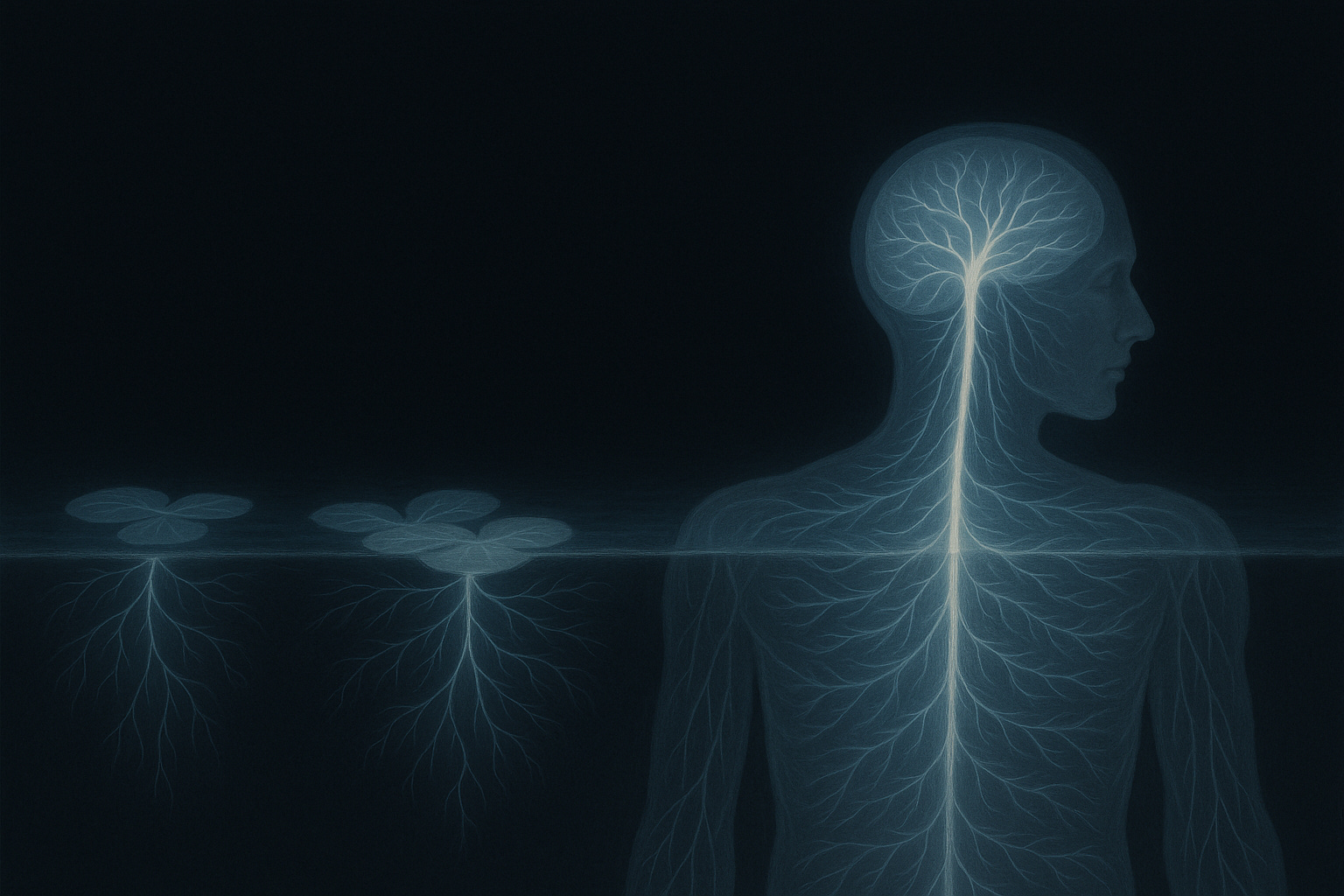
When fear overwhelms the system, the vagus nerve (the rootline between brain and gut) can shut everything down.
You freeze.
You faint.
You shit yourself.
Resmaa Menakem writes,
"The body, not the thinking brain, is where we experience most of our pain, pleasure, and joy."
I hadn't read any of his work when I came across that line. But it stopped me. Not because it was new, but because it named something my body already knew. It made me pause and trace back: Where had I felt that before?
I felt this shit in my bones long before I read it in some book. Literally. The body keeps score whether you're ready for the tally or not.
My gut started talking back before I knew how to listen. Stomach aches twisted through my childhood while my mom pushed iced water and saltines like folk magic. "Just lay on your stomach!" Ancient remedies for wounds she couldn't see. It was mother-magic that never quite worked, but we both pretended it did.
Then came the military. That perfect machine designed to break bodies in the name of building them. That's when everything amplified to a frequency I couldn't ignore. Finally saw a doctor who slapped labels on my symptoms like price tags: IBS. GERD. Here's your receipt, soldier. He handed me industrial-strength Motrin for my splintering shins and told me to take it before PT on an empty stomach, pre-breakfast, like some ritual sacrifice to the gods of gastrointestinal distress.
I didn't understand then how this was basically napalming my already scorched insides. No one bothered connecting those dots. They didn't look below the surface symptoms, didn't ask about the underground root system feeding the visible dysfunction. Classic military medicine: fix what's broken enough to keep the machine running, but never ask why it broke.
But somewhere beneath my conscious mind, my body knew. It was screaming in a language I hadn't yet learned to translate, but would eventually have no choice but to study. Like roots shifting under frozen soil. Slow, invisible tremors that still cracked the surface. Trembling before they ever stabilized.
My body had been trying to process what I couldn't say out loud. The pressure, the clenching, the internal recoil anytime I got too close to truth, especially with people I needed it from most.
Once, I shit myself in a parked car. Not from illness. Not from movement. Just from trying to say something I'd carried too long, with someone I'd been trying to feel safe with since I was a wee lad. I was sober. In my thirties. Doing the work. And still, my body collapsed.
And to be clear, that wasn't the first or last time. It's happened more than once. Different places, different triggers, but always the same core truth: my body letting go when words couldn't. When the nervous system reached its limit and the root system buckled from the weight of what hadn't yet been released.
It was humiliating. Not just because of the mess, but because I thought I had outrun this. I thought healing meant control. But the body doesn't care about performance. It cares about protection. And sometimes, collapse is its last defense.
That's how deep the fear went.
Of being real.
Of being received.
Of being punished for it.
It's not weakness. It's programming.
It's an ancient reflex, saying:
"Survival now. Dignity later."
Root denial: when the body screams for relief, but the world demands containment.
Basic training was my first big lesson in this.
I had to pee before we even got off the bus at Fort Jackson. But once those doors opened and the drill sergeants descended, there was no room for bodily needs.
Hours passed: nonstop movement, orders, noise, fear.
Still had to go.
The pain sharpened. My body clenched tighter.
By the time we were finally allowed to use the bathroom, I could barely stand—but I couldn't release. I stood at the urinal in agony, unable to pee. My whole system had locked down.
That was my first real experience of how the nervous system can override even the most basic human needs.
And maybe that lesson started even earlier.
For years, I joked about having a "child's bladder." But the truth is more complicated. I learned to hold it young, not just physically but emotionally. I wet the bed well into elementary school, and the shame that came with it shaped something silent and enduring in me.
Waking up in tears. The fear of being found out. The way even my mom trying to cope, maybe, would tell other adults. I felt exposed. Like I had failed to contain something I was supposed to control.
And so I did what many of us do: I got better at holding.
Even now, I sometimes feel the urge hit strong after a cold breeze, or a sudden shift. But if I stay still and remind myself I just went, the feeling fades. I wait. I clench. I override.
It's not just about urine.
It never was.
It's about the earliest ways we learn to manage need, sensation, vulnerability.
And how that management can become a lifelong posture.
So what does it mean to be rooted?
Gabor Maté says,
"Safety is not the absence of threat. It is the presence of connection."
That kind of safety, the felt, embodied kind, only arrives when connection does. When we're seen, or held, or even just allowed to collapse without being punished for it. Because it's not just the collapse that hurts. It's everything we did to hold it in. The clenching, the override, the bracing. We're not taught how to feel pain without resisting it. We're taught that discomfort means something's wrong, that stillness should feel serene, that healing should feel good. So when pain shows up in meditation, in stillness, in recovery, many of us panic. We think we're doing it wrong. But maybe the resistance is the real injury. Maybe healing means learning to sit with the wave instead of trying to stay dry. Safety doesn't erase pain. It invites the body to stop fighting it. And it's this presence of connection that signals the vagus nerve:
You're safe now.
Not just intellectually, but physiologically, at the root level.
It's how the body learns, over time, that it no longer needs to brace.
It's understanding what we've been holding.
And trusting the body's timing in its release.
Sometimes we hold because we must.
Sometimes we let go because we finally can.
And sometimes we break because we've been holding for too long.
Rootedness isn't just about standing strong.
It's about knowing when to soften.
It's about feeling your feet in the ground while your body trembles and still saying:
This is me staying.
The duckweed lesson.

Rumi knew this,
"Try to stay in the middle of the river. That's where the current is strongest, and the boat stays most steady."
Maybe rootedness isn't stillness. Maybe it's learning how to stay with ourselves in the flow.
And lately, I've found an unlikely teacher in a patch of duckweed, a gift from a neighbor’s aquarium, shared freely from their tank to mine. Like so much in nature, it came through relationship, a small act of exchange that mirrored everything this essay holds.
Each one floats freely but still grows, sending down delicate roots like tendrils of a nervous system adjusting to new stimuli, mapping safety, reshaping itself in real time. It's not just biological. It's somatic memory taking root that drifts and reorients with the water. They swirl together under the bubbles, separate but not disconnected. Constantly moving, but never lost.
Biologically, duckweed absorbs nutrients and light more efficiently when it circulates gently. Movement distributes oxygen and prevents rot. But they still need pauses. Moments of stillness where roots can soak and stabilize.
And it's not just duckweed. I've seen it with bamboo, pothos, a plethora of persistent plants. As long as the transfer is done with care, mindful of roots, gentle with transition, plants don't just survive being moved. They fucking flourish magnificently amidst the flow.
It's not the disruption that breaks them.
It's the manner of movement.
The presence or absence of compassion.
They regulate together. One bump sends ripples through the whole surface.
What if we're like that too? What if the discomfort of closeness, the awkwardness, the fear, the overwhelm, isn't what disconnects us, but our resistance to it? Maybe if we stopped tightening against the feeling and let ourselves keep moving, we could actually form something real. Not permanent, but real. A brief, stable conductivity. Like duckweed swirling near another root system just long enough to share rhythm, to remind each other how to stay connected in motion.
We're wired to root together.
There's a deeper truth under the forest floor. Trees communicate through mycelium, sharing nutrients and warnings via vast underground networks. What looks like separate trees are often connected, sustaining one another in invisible ways.
Our guts operate the same way. Entire forests of fungi and bacteria collaborating below our awareness. When that internal ecosystem breaks down, the healing doesn't always come from within. Sometimes, it's passed on. Fecal transplants, literal microbial rootedness, have become one of the most effective tools for restoring balance after damage. It's healing through relationship. Through rhythm. Through someone else's survival still living in them.
Honestly, what better metaphor for care in the community than someone else's shit helping you rebuild your gut? Disgusting. Miraculous. Biology at its most generous and least glamorous. A small act of exchange, passed from one body to another, that mirrors this entire rhythm, however unappetizing.
Our nervous systems work similarly. We co-regulate. A shift in someone's breath can alter our own. Sometimes even a faint bodily signal, a shift in heat, the ghost of a scent, the unclaimed warmth of a passing breeze, can ripple through a room. Not all co-regulation is graceful, but it's all real. And just as often, it's the scent or the pressure change that unlocks something older. An emotion, a memory, or a bodily reaction whose origin we no longer consciously recall. The body remembers even when we don't. Their solid presence can help stabilize our internal trembling. But a not-so-solid presence, or even a familiar one in the middle of a fight, can send the opposite signal. The body tenses, the gut clenches, and the mind reaches for an explanation. We often assume: 'You're the problem.' Not the memory. Not the charge. You. And if we don't know what our nervous system is doing, we'll believe that story and act from it. We won't even know what we're actually fighting about, only that it feels urgent. Dangerous. Unbearable. All we know is: we're not okay, and someone must be to blame.
And this is where rootedness gives us an option. A space. Not always to stay, but to choose. The autonomic nervous system has a kind of half-life. A measurable time it takes to settle after activation. Sometimes the most grounded thing we can do is step away. Not to escape, but to give the body a chance to settle before we re-enter. Because that space between stimulus and response? It's not just a metaphor. It's a physiological pause, and in that pause lives the possibility of not repeating the pattern. That's not weakness. That's wisdom.
When you're truly rooted, you don't just hold yourself. You help ground those around you.
Sometimes that grounding shows up as a person.
Sometimes it's a cat who doesn't care about your trauma, but insists on curling up beside you every time you start to spiral. Or just because. BaeBae, my feline familiar, has kept me rooted more times than I can count, just by being there, refusing to leave.
And yet, I still haven't found the best spot for her litter box. Probably because placing it would mean confronting the full truth of our domestic co-regulation. Some grounding, it turns out, comes with odors.
Healing lives in rhythm.
Maybe that's the point of all this. Grounding isn't static: it's rhythmic. Even BaeBaeKitty curls into me, then wanders off, then returns again. Breathe, drift, return. That's how roots stretch too: not all at once, but in waves.
Gentle stimulation, even stress, can build resilience, if we're given the space to integrate it.
We grow not just in calm, but in the rhythm between motion and recovery.
Move, rest, return.
I haven't done the experiments yet, but I imagine the baby duckweeds that grow best are the ones that ride the current a bit. Stirred, stretched, then return to stillness. Like they went on a tiny journey, then came home.
Maybe the current strengthens them.
Maybe the contrast deepens the root.
Maybe both.
I used to think collapse was failure, especially the messy ones. But maybe those were just the body's way of breaking rhythm to find a better one. A last-ditch release, so the roots could finally rest. Not elegant. Not clean. But honest. And sometimes, honest is the only thing that holds.
This is me remembering.
Maybe that's what healing looks like.
Not one perfect truth, but a rhythm of truths. Each surfacing as we swirl, settle, and grow again.
The words I quote don't just inspire me. They remind me. Of the rhythm already moving in me before I had language for it. Of how rooted wisdom doesn't just speak. It pulses. Like the body, like the ground, like memory finding its breath. Of what I'm already living into.
Quoting them isn't decoration. It's memory, an echo of what my body already knew before my mind could name it.
It's me remembering I'm not the first to feel this, and I won't be the last.
It's tracing my roots through others like duckweed near the surface or mycelium beneath it, quietly reminding me that connection often begins underground. A way of saying: This wisdom didn't start with me, but I carry it now.
And maybe, just maybe,
we've stopped running long enough to notice how even the small, quiet anchors, the curl of a cat, the sigh of our own breath, can root us back into our bodies,
transforming what we've been holding into what holds us,
to feel held,
not just by others,
but by the roots we've finally come home to.
 | A guest post by
|